






- Article published at:
- Article author: Crystal Cheng
- Article comments count: 0
Nanjing: The University City Where China's Software, Chips, and 2,500 Years of History Meet
A 600-year-old city wall around China's first $144-billion software city — and the universities that feed it.
Business Tours > Universities, Software & Culture > Nanjing Best for: Software & AI, Semiconductors, Culture & History
By day Nanjing sells 2,500 years of dynasties; by night its software and chip parks keep running.
Walk Nanjing's Ming city wall and you touch the longest intact city wall on Earth — 25 kilometers of brick laid in the 1360s that still rings the old city. Behind it sits a capital that has been China's political and cultural heart for more than 2,500 years, home to six imperial dynasties and China's only UNESCO City of Literature.
Behind those walls, Nanjing is also one of China's great university cities — 53 universities and more than a million students feeding a tech economy that includes China's first $144-billion software sector and one of its densest chip clusters. For a business traveler, the question is what Nanjing builds now — and why 2,500 years of history still shape the engineers, researchers, and companies you will meet here.
Nanjing is the ancient capital that learned to code — six dynasties of history wrapped around a $144-billion software economy.
Nanjing at a Glance
$273B 2025 GDP, +5.2%
53 Universities in the city, with 1 million-plus students
$144B 2025 software revenue — China's 1st $144-billion software city
$42B+ Jiangbei New Area IC output, 300+ chip firms
Translation: a mid-sized economy, but one of the highest concentrations of universities, software, and chips you can visit in person.
What Nanjing Does Best
Its universities power a software and chip economy.
Nanjing is a university city first. It hosts 53 universities and more than a million students — one of China's densest concentrations of higher education. That talent pipeline feeds everything else.
Software is the headline. In 2025 Nanjing became China's first $144-billion software city, with revenue of roughly $144 billion. The cluster sits in China (Nanjing) Software Valley in Yuhuatai district — 4,900-plus firms and 370,000 tech workers. Huawei and ZTE anchor it, and the city is pushing hard into artificial intelligence.
The same talent base supports chips. Across the Yangtze in Jiangbei New Area, TSMC runs one of mainland China's most advanced volume fabs, surrounded by more than 300 chip firms covering design, manufacturing, and packaging. The output tops $42 billion — and TSMC's presence has pulled equipment makers, design houses, and packaging firms into the same dense cluster.
Huawei Nanjing
ZTE Nanjing
TSMC Nanjing
Nanjing University
The Nanjing You'll Want to See on the Side
The city wall is the spine of any visit. Built from 1366 to 1393 with nearly a million workers, the Ming wall originally stretched 35 kilometers; 25 kilometers still stand, making it the longest surviving brick-and-stone city wall on Earth. Below it lies Xuanwu Lake, a former imperial garden, and nearby Jiming Temple — a 1,500-year-old monastery that frames the lake and the wall in one view.
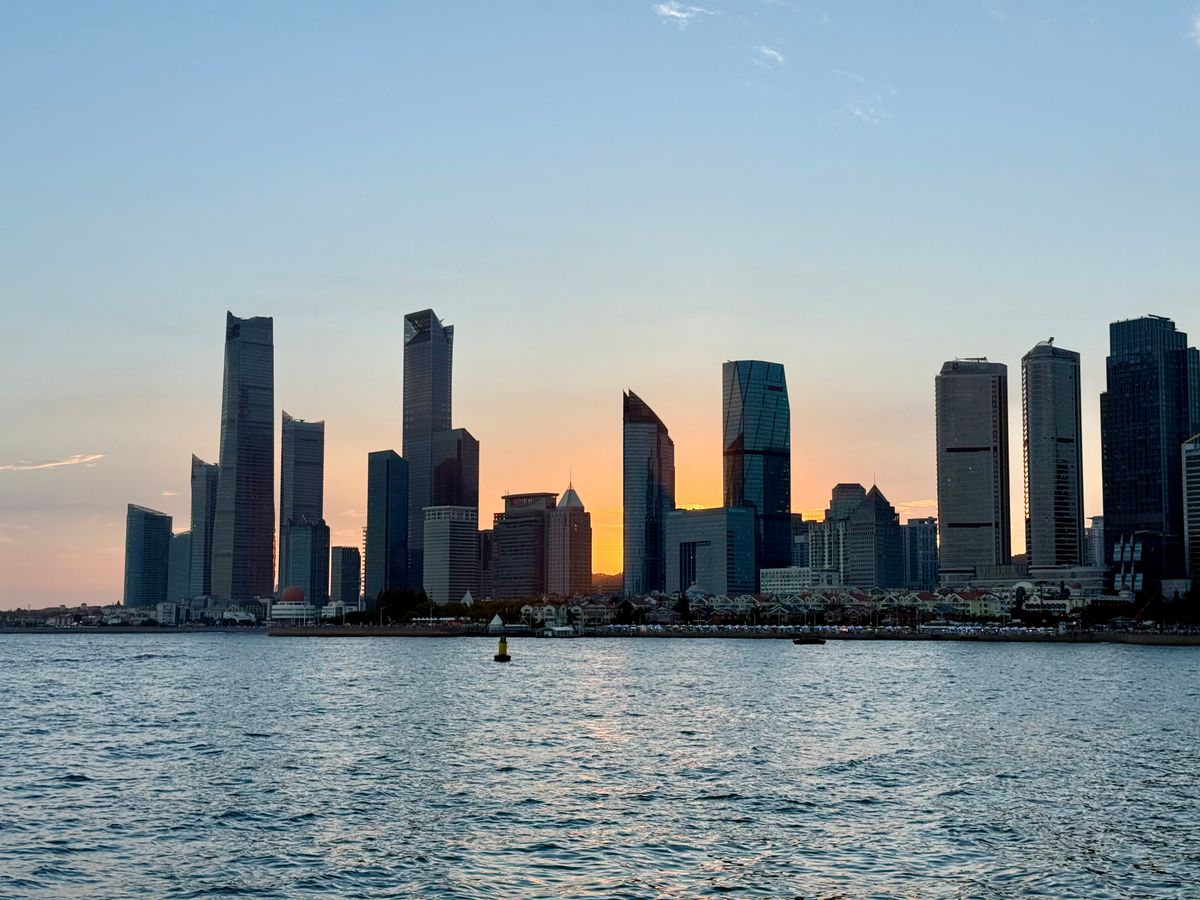
Xuanwu Lake at dusk, with Nanjing's skyline rising beyond the old city.
Purple Mountain holds the Sun Yat-sen Mausoleum, a white-marble memorial climbing through pine forest to honor modern China's founder. Back in the city, the Nanjing Museum holds one of China's deepest collections — Ming porcelain, jade, and republican-era relics.
Then there is Niushou Mountain. Its Usnisa Palace opened in 2015 on the site of a 60-meter-deep former mine pit: a 136,000-square-meter Buddhist complex built to house a sacred Buddha relic. Inside are a 7.5-meter reclining Buddha, the 10,000-Buddha corridor, and the golden stupa of the Thousand-Buddha Hall — the kind of scale that makes visitors stop and stare.
The Usnisa Palace at Niushou Mountain, mirrored in its reflecting pool — a Buddhist complex built into a former mine pit.
At night the Qinhuai River mirrors the lantern-lit pavilions of the Confucius Temple district. Local duck dishes — salted duck above all — are a Nanjing signature found in nearly every restaurant near the wall, a footnote to the history, not the main story.
What You Can Actually See and Visit
China (Nanjing) Software Valley Arranged visit
Nanjing's software and AI cluster — 4,900-plus firms and 370,000 tech workers. See the park exhibition center, enterprise R&D floors, and AI workspaces.
TSMC Nanjing & Jiangbei Chip Cluster Arranged visit
One of mainland China's most advanced volume chip fabs and a 300-plus-firm cluster across the Yangtze. Visit the industry exhibition hall and chip-design parks.
Nanjing University & Research Park Arranged visit
One of China's top research universities — see the innovation park, university-enterprise labs, and the pipeline that feeds Nanjing's software and chip sectors.
Sun Yat-sen Mausoleum Open to public
A white-marble mausoleum climbing Purple Mountain through pine forests, honoring modern China's founder. A UNESCO World Heritage site.
Confucius Temple & Qinhuai River Open to public
A lantern-lit riverside old town where the Qinhuai water mirrors pavilions and street life. Best at night.
Nanjing Museum Open to public
One of China's deepest collections — Ming porcelain, jade, and republican-era relics across grand halls.
Being honest about access is part of our service: what's listed as "arranged" needs a business introduction — which is exactly what we do. Wafer fabs, software-park R&D floors, and university labs are employees-only. We never sell access that doesn't exist.
Want to see Nanjing's university-powered tech sectors?
We design custom business trips to Nanjing and the Yangtze Delta — tailored to your industry, your objectives, and your schedule. We handle company introductions, interpreter arrangements, factory visits, and logistics. You focus on the insights.
Explore China Contact Us
Learn More

