Dengfeng
Shaolin Temple & Pagoda Forest
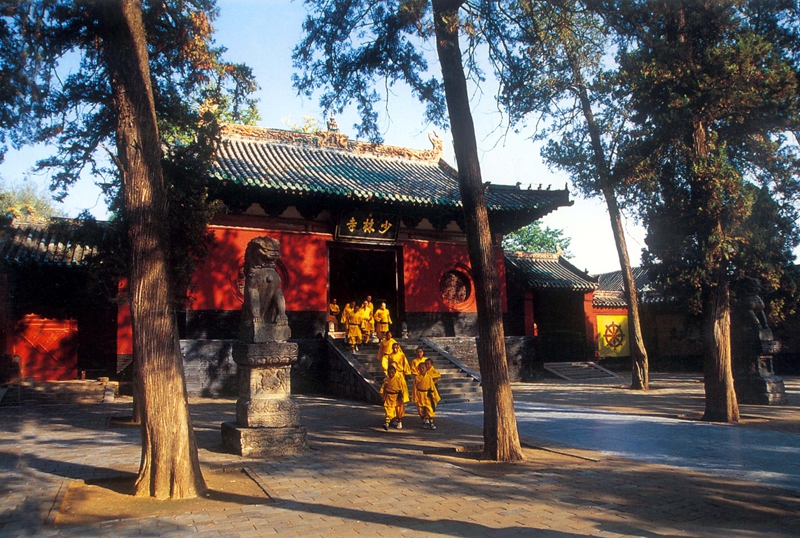
Walk the main courtyards, look for historic steles, see a public kung-fu demonstration, and continue to the Pagoda Forest, where memorial pagodas preserve the memory of eminent monks.

Drawer menu

Long before many international travelers could place Henan on a map, they already knew its visual language: shaved-headed monks, horse stances, impossible balance, and a training courtyard beneath a mountain. Hong Kong cinema carried the Shaolin culture around the world, and Hollywood later folded it into its own kung-fu vocabulary.
Chinese martial arts have a much longer and more compilicated history than shaolin alone,of course.But few places have had such a strong influence on how the world sees Chinese KungFu.
Part of what makes Shaolin so fascinating is that martial arts here have never existed on their own.They are tied to temple life,discipline,and Chan Buddhist practice.And for all its fame,Shaolin Temple is not simply a historic site or a place built for tourists.It is still an active Buddhist temple,where training and religious practice continue today.
Pat makes a visit feel different from what you might expect.Behind the familiar image of Shaolin Kung Fu is a tradition that is still alive and changing,attracting people who come not only to train physically,but also to build focus,patience,and discipline.

Shaolin Temple is the real place behind one of the world’s most recognizable martial-arts myths: a 1,500-year-old monastery where Chan practice, kung fu, historic inscriptions, international students, and modern celebrity culture now meet.
At a Glance
495 CE
Shaolin Temple was established during the Northern Wei dynasty.
499 steles
Record 1,424 years of religious, social, cultural, and political history.
1982
Jet Li’s Shaolin Temple helped launch a new wave of global fascination.
10 days
Victor Wembanyama’s reported Shaolin stay for meditation and kung-fu practice in 2025.
Shaolin’s international fame owes as much to cinema as to history. The temple had appeared in martial-arts storytelling long before the modern film industry, but the 1982 movie Shaolin Temple, starring a young Jet Li, was a turning point. Its landscapes, training sequences, and heroic image of the monks helped create a new “Shaolin fever” and made the actual monastery a destination for audiences who had first encountered it on screen.
Hollywood later borrowed the same visual grammar: the disciplined master, the punishing repetition, the student who must control the mind before mastering the body. What cinema compresses into a training montage, Shaolin culture treats as long practice. Flexibility, stance work, weapons, forms, breathing, concentration, and moral discipline are not separate attractions; they belong to a system in which physical skill is supposed to be governed by awareness.

A public demonstration is therefore best understood as an introduction, not the whole story. The jumps and weapon routines are spectacular, but the more revealing details are often quieter: how students repeat a movement, how they recover balance, and how a group moves as one.
Shaolin Temple was established in 495 CE under Emperor Xiaowen of the Northern Wei for the Indian monk Batuo, also known as Buddhabhadra. Its location below Shaoshi Mountain gave the monastery its name. Over the centuries, Shaolin became closely associated with Chan Buddhism and with martial traditions shaped by monastic life, local defense, physical conditioning, military exchange, and repeated reinvention.
The Founder
Batuo
The Indian monk for whom the original temple was established in the fifth century, anchoring Shaolin in the early transmission of Buddhism in China.
The Chan Tradition
Bodhidharma
Tradition links Bodhidharma with meditation at Shaolin and the development of Chan. His story is central to the temple’s identity, although later legends should not be mistaken for simple documentary history.
The Living Lineage
Generations of Monastic Masters
Shaolin kung fu was not invented by a single master. It accumulated through generations of teachers who preserved, organized, debated, and adapted practice.
The stone inscriptions at Shaolin offer a very different picture from the legends. According to UNESCO’s Memory of the World register, 499 steles survive today, dating from 566 to 1990. Together, they preserve more than 1,400 years of history, recording Shaolin’s connections with rulers, scholars, local communities, and Buddhist monks from abroad.
They are also a good reason not to rush through the temple. Sometimes a weathered inscription, an old tree, or a hall rebuilt after a fire can tell you more about Shaolin’s history than the kung fu performances most visitors come expecting to see.
Over the centuries, the temple has lived through periods of imperial support, war, fire, rebuilding, and, more recently, mass tourism. Shaolin has changed many times, but it has never simply disappeared into the past.
Modern Shaolin speaks to the world in several languages at once. It remains a religious site, but it is also a heritage destination, a training culture, an international symbol, and a network of schools and cultural exchanges. In 2022, Xinhua reported that about 2,000 foreign visitors came each year to learn kung fu and experience Shaolin life, while an online competition drew more than 5,000 participants from 90 countries and regions.
For international visitors, “training at Shaolin” can mean very different things: watching a public demonstration, joining a short cultural program, studying at a nearby martial-arts school, or entering a longer and more demanding course. None of those should be confused automatically with private monastic instruction. The experience is real, but access, teachers, standards, and schedules must be checked carefully.
A Modern Shaolin Story
Why an NBA star came to practise in Henan
In June 2025, San Antonio Spurs star Victor Wembanyama spent about 10 days at a Shaolin temple, where reports described him practising Chan meditation and Shaolin kung fu during a broader return-to-performance journey. One year later, he led the Spurs to the NBA Finals and was named Western Conference Finals MVP; San Antonio finished as runners-up. It would be careless to claim that one retreat produced those results. What matters is that an elite athlete chose Shaolin for concentration, discipline, balance, and unfamiliar movement—not as nostalgia, but as a modern training experience.
That choice explains Shaolin’s contemporary appeal better than another legend. The temple’s value is not limited to reproducing an ancient form exactly as it once existed. Its practices continue to invite new questions: how do you remain calm under pressure, move efficiently, repeat without becoming careless, and make physical skill answer to attention?
Make Shaolin the anchor, then add one or two places that reveal how much larger Henan’s story is. These are the most useful starting points for a first-time international visitor.
Shaolin Temple & Pagoda Forest
Walk the main courtyards, look for historic steles, see a public kung-fu demonstration, and continue to the Pagoda Forest, where memorial pagodas preserve the memory of eminent monks.

Longmen Grottoes
Thousands of caves, niches, inscriptions, and Buddhist images line the cliffs beside the Yi River. Longmen turns the history of belief and imperial art into a landscape you can walk through.
Photo: Tgasrio / Wikimedia Commons, CC0.

Yinxu & China’s Earliest Writing
The late Shang capital reveals royal tombs, palace foundations, bronzes, and oracle bones. It is one of the strongest places in China to connect archaeology with the origins of the written record.
Photo: Gary Todd / Wikimedia Commons, CC0.

Henan Museum
If your route is short, start here. The museum gives essential context for Henan’s bronzes, ceramics, dynasties, trade, music, and archaeology before you travel outward to individual sites.
Photo: xiquinhosilva / Wikimedia Commons, CC BY 2.0.
Only Henan · Drama Fantasy City
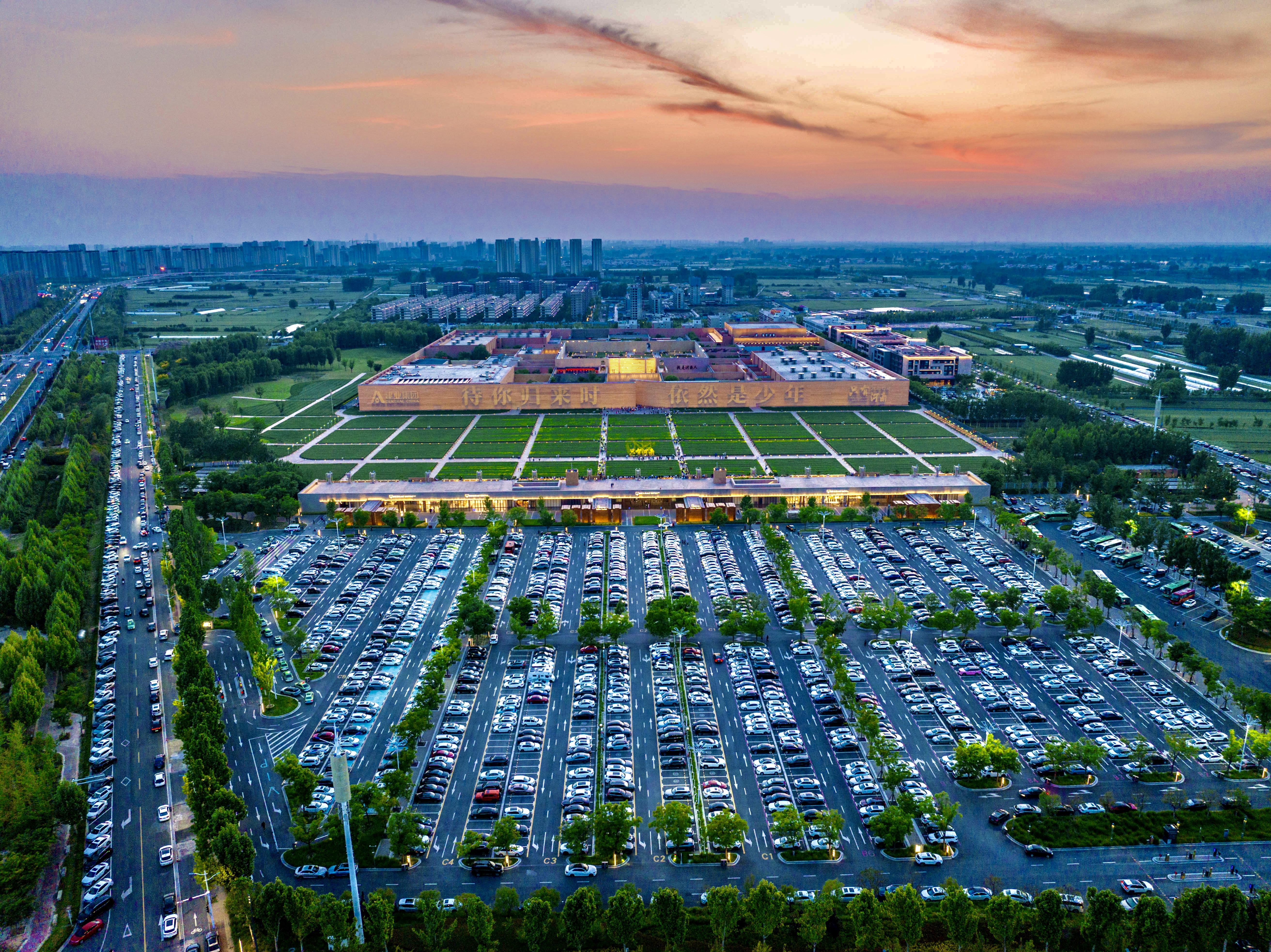
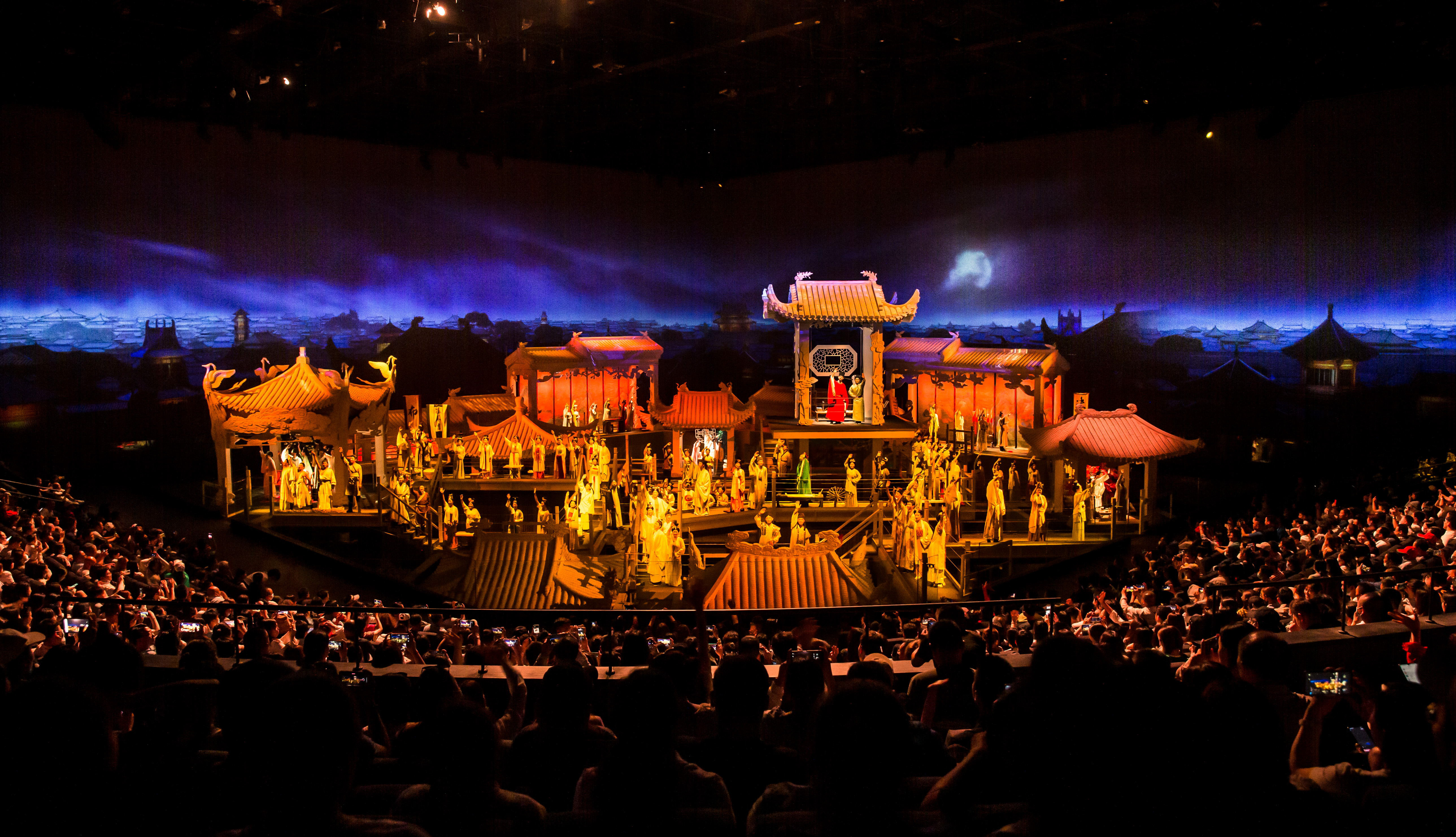
Located in Zhongmu, an eastern area administered by Zhengzhou, the complex turns Central Plains history, migration, famine, family memory, and rural life into large-scale immersive theatre. Visitor listings commonly describe the address as Zhongmu County, while newer local publicity uses Zhongmu New Area. It is emotional and theatrical rather than archaeological—a useful modern counterpoint to Shaolin, Longmen, and Yinxu.
Henan is not only a museum of early China. It is also one of the country’s most important food-production regions. With roughly one-sixteenth of China’s arable land, the province produces about one-tenth of the nation’s grain and around one-quarter of its wheat. That agricultural base, combined with central transport links and a huge consumer market, helped Henan turn raw ingredients into a modern food-manufacturing ecosystem.
The interesting business story is the chain from field to factory to mass-market brand. Zhengzhou became a center for frozen foods and consumer logistics; Luohe developed a powerful food-processing cluster; and local companies learned how to sell inexpensive, standardized products across an enormous national market. By late 2024, Henan’s modern food industry was reported to have reached roughly one trillion yuan in output.
 MixueZhengzhou · Drinks
  WeilongLuohe · Spicy snacks
  SanquanZhengzhou · Frozen food
  ShuanghuiLuohe · Meat processing
Mixue grew from a small Zhengzhou business into a global drinks chain. Weilong transformed latiao, a spicy wheat-based snack, into a packaged consumer brand. Sanquan helped industrialize frozen dumplings and sweet rice balls, while Shuanghui made Luohe nationally synonymous with large-scale meat processing. Together, they show a side of Henan that foreign visitors rarely expect: practical, high-volume, brand-conscious, and deeply connected to the province’s role as China’s granary.
That contrast is the best reason to look beyond the usual Shaolin postcard. Henan can move from a monk’s stone inscription to an oracle bone, from a Buddhist cliff carving to immersive theatre, and from a wheat field to a global storefront. Shaolin is the hook—but the province around it is the larger story.
Editorial sources
Key facts were checked against UNESCO Memory of the World, the UNESCO Dengfeng listing, the UNESCO pages for Longmen Grottoes and Yinxu, Xinhua’s international Shaolin feature, NBA/AP reporting on Victor Wembanyama’s 2025 visit, NBA’s 2026 conference-finals report, the People’s Government of Henan Province, and Invest in China. Visitor access and schedules can change; verify current details before travel.
